Institutional Staking and Vaults for Custodians
Staking and vaults. Zero custody risk.
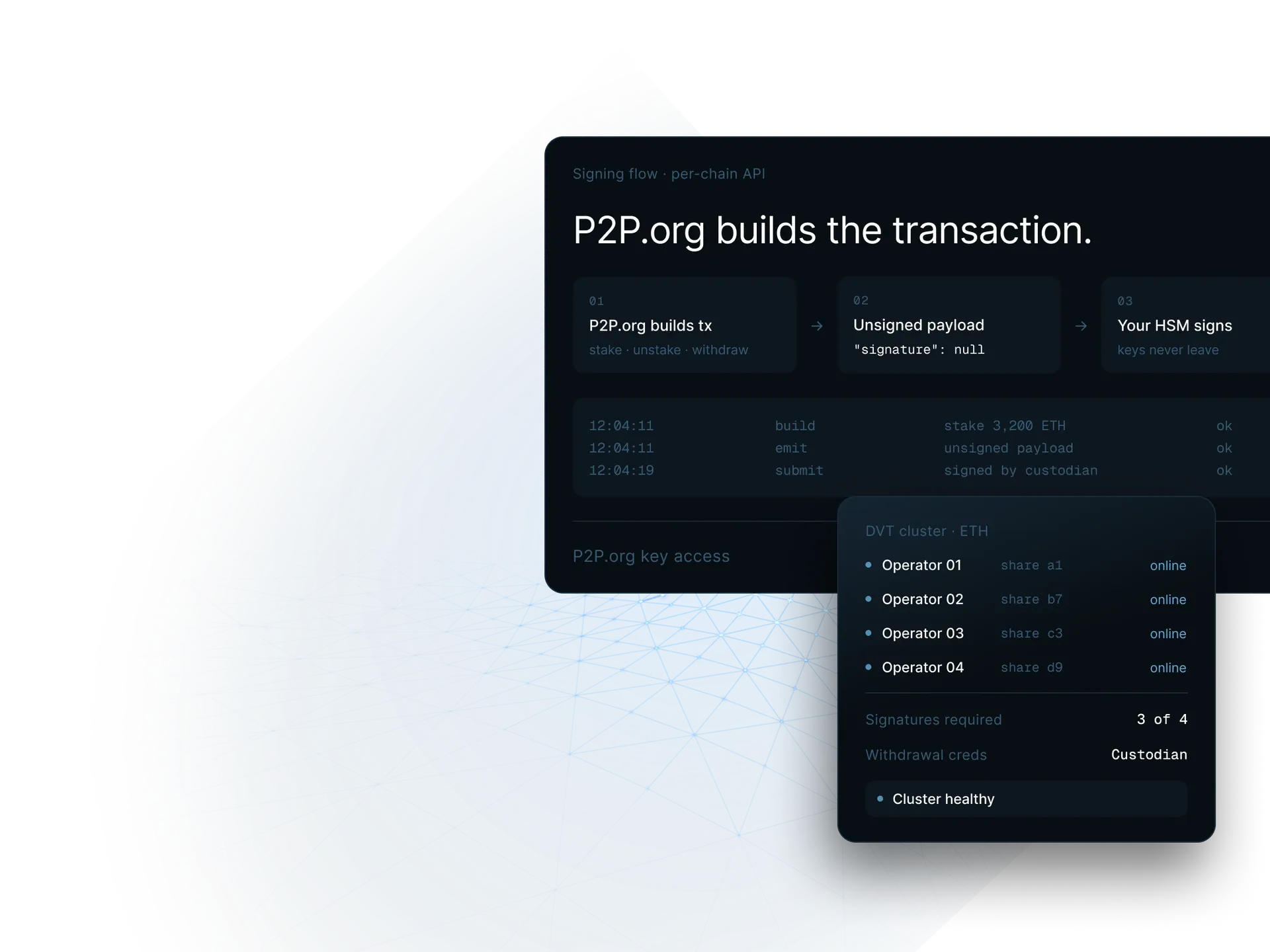
P2P.org's Unified API gives custodians and MPC platforms non-custodial staking across 35+ networks through a single integration. P2P.org generates unsigned transactions only. The custodian's vault completes every transaction. DVT staking via SSV Network and Protected Vaults extend the offering without custody ever leaving the client.
Non-Custodial Staking Built for Custodians
Custodians and MPC platforms cannot adopt staking infrastructure that requires releasing custody at any point. P2P.org's architecture is built around that constraint from the ground up.
Transaction model
Unsigned only
Staking control
Per-chain API
Validator setup
DVT staking
Reporting via
Staking Data
Security & Compliance



Products
Products for Custodians
*Protected refers to security and operational controls, not a guarantee of returns.

Unified API
One key across 35+ networks. Returns an unsigned transaction the custodian's vault signs. The primary integration entry for custodians and MPC platforms.

Staking API
Per-chain non-custodial staking layer beneath Unified, for custodians requiring chain-specific control. Only unsigned transactions generated.

DVT Staking API
Distributed validator technology via SSV Network. Two integration paths: SSV 1.0 direct or SSV 3.1 proxy. Four operators, no single point of failure.

Protected Vaults*
Offer simple vault yield on top of institutional-grade collateral. Transparent parameters, overcollateralized markets, built for security-conscious clients.

Staking Data
Validator, network, and delegator data across 7 networks. Reward history, balances, and withdrawal status for reconciliation and reporting.

Wallet Data API
Portfolio and position visibility layer for custodians with cross-chain reporting needs. Balances, transactions, and DeFi positions in one interface.


P2P.org by numbers
P2P.org is a non-custodial staking and DeFi infrastructure provider serving institutional clients across 35+ blockchain networks. Founded in 2018, P2P.org operates validator infrastructure, DeFi execution controls, and transaction data services for custodians, exchanges, asset managers, wallets, and treasury teams worldwide.
Networks supported
35+
Institutional digital assets secured
$10B+
Dedicated support
Global
Operating infrastructure since
2018
Institutional clients
190+
Slashing events track record
Zero
Trusted by industry leaders












Frequently Asked Questions
Help centerNo. P2P.org generates unsigned transactions only. The custodian's vault or HSM signs every stake, unstake and withdrawal, and withdrawal credentials stay with the custodian throughout. Keys never leave the client.
Through the Unified API: one key covers 35+ networks and each call returns an unsigned transaction for the custodian's vault to sign. Custodians that need chain-specific control integrate the per-chain Staking API beneath it. Both paths generate unsigned transactions only.
Distributed validator technology splits a validator's key across four independent operators via SSV Network, so no single operator holds the full key and no single failure takes the validator offline. Custodians use it to remove single points of failure from their staking setup. Two integration paths are available: SSV 1.0 direct or SSV 3.1 proxy.
Staking Data provides validator, network and delegator data across 7 networks: protocol-issued reward history, balances and withdrawal status for reconciliation and client reporting. The Wallet Data API adds cross-chain balances, transactions and DeFi positions for custodians with broader reporting needs.
The Signer SDK signs transactions locally across 15+ networks and supports airgapped signing environments, so it slots into the custodian's existing key management rather than replacing it. Unsigned transactions from the Unified or Staking API can be signed with it or with the custodian's own HSM or MPC setup.
P2P.org is SOC 2 Type II attested and ISO/IEC 27001:2022 certified, and is a BSSC member. Compliance documentation is available on request through the Trust Center.