Why Institutional Capital Needs a Protection Layer in Proof-of-Stake Networks
Published · Updated
Series: Institutional Lens | Validation Infrastructure
Summary
Proof-of-stake networks have crossed a threshold. With over 30% of Ethereum's total supply now staked — representing more than $100 billion in economic security — institutional participants are no longer early adopters. They are load-bearing infrastructure. That changes the risk calculus entirely. For digital asset custodians, ETF issuers, treasury teams, and crypto-native funds, participation in validator networks is no longer primarily a question of reward optimization. It is a question of operational governance, risk architecture, and institutional accountability. This piece explains why a validator protection layer — a defined set of operational, technical, and governance safeguards — is no longer optional for institutions operating at scale in proof-of-stake environments.
If You Only Have Two Minutes
This article is the first in the Institutional Lens series, which unpacks protocol mechanics and infrastructure decisions for institutional participants in proof-of-stake networks.
Recommended reading: Before or after this piece, explore our breakdown of how slashing works at the protocol level — a direct companion to the governance and risk architecture discussed here: → Ethereum Slashing Explained: What Custodians, Funds & Exchanges Must Know
What this piece covers:
- Why institutional scale amplifies validator risk exposure
- What a protection layer actually means operationally
- The governance and capital implications of getting it wrong
- What to look for in a validator infrastructure partner
Who This Is For
This article is written for professionals operating at the intersection of institutional finance and blockchain infrastructure. Specifically:
- Digital asset custodians managing staked positions on behalf of clients
- ETF and ETP issuers with staking-enabled products or pending approvals
- Crypto-native funds and treasury teams with direct validator exposure
- Staking product managers and validator risk committees assessing partner infrastructure
- Infrastructure engineers responsible for validator operations and key security
If you are deploying, managing, or overseeing significant staked capital in proof-of-stake networks, the risk dynamics described here are directly relevant to your operational posture.
The Institutional Inflection Point
Institutional participation in proof-of-stake networks has moved from exploratory to structural. Between January and June 2025, the amount of staked ETH rose from 34 million to 35.3 million, reaching approximately 29% of the total supply (CoinLaw). By early 2026, that figure had crossed 30%: a milestone that reflects not just retail participation, but deep institutional commitment.
Institutional funds currently hold approximately 3.3 million ETH, so around 3% of the circulating supply, through exchange-traded funds alone. With staking ratios already above 27%, ETF staking approvals alone could increase total staked ETH by more than 10% (CoinDesk).
This is no longer a niche phenomenon. Banks, asset managers, hedge funds, pension funds, venture capital firms, and centralized exchanges have all entered the sector. Staking solutions designed specifically for professional investors have gained significant momentum, shaping a distinct vertical now known as staking-as-a-service (CoinShares).
The regulatory backdrop has also shifted decisively. In Europe, the MiCA framework provides clear operational and compliance requirements for regulated entities. In the United States, the SEC's August 2025 decision not to classify liquid staking as a security removed one of the main legal obstacles for large allocators. The IRS subsequently issued new guidance providing a clear path for trusts to stake digital assets without jeopardizing their tax status (CoinShares)
All of these points to the same structural reality: institutional capital is now deeply embedded in proof-of-stake infrastructure. And with that comes a risk exposure that did not exist at scale before.
What Risk Actually Looks Like at Institutional Scale
The risks of validator participation are protocol-defined and well-understood. What changes at institutional scale is the magnitude of consequence.
Slashing: Rare, But Asymmetric
Slashing is the protocol-level penalty applied when a validator behaves in ways that threaten network integrity, primarily double-signing or prolonged inactivity. Historical data shows that only 0.03% of all Ethereum validators have ever been slashed since staking launched in December 2020. Of those, the largest realized loss was approximately 3% of staked capital (iShares).
Low frequency does not mean low consequence. In September 2025, 39 validators were slashed in one of the largest correlated slashing events since Ethereum's transition to proof-of-stake. The incident was traced to operator-side infrastructure issues involving third-party staking providers (CoinDesk). What began as an operational failure at the infrastructure layer resulted in compounded penalties — because when multiple validators are slashed simultaneously, Ethereum's protocol enforces additional inactivity leaks that amplify the financial impact.
For a deeper breakdown of how slashing mechanics work at the protocol level, see: Ethereum Slashing Explained: What Custodians, Funds & Exchanges Must Know
For an institution managing hundreds of millions in staked capital, a correlated slashing event is not a theoretical scenario. It is a risk that must be engineered around.
Operational and Key Security Risk
Institutions that run their own validators or manage staking operations in-house may face challenges in securely managing private keys, validator operations, rewards tracking, and protocol upgrades. These processes require specialized infrastructure and consistent operational uptime, introducing technical complexity and potential security vulnerabilities if operators lack deep experience (Coinbase).
Validator key compromise, while rare, carries consequences that extend well beyond the immediate staking position. A compromised key is an operational incident, a governance incident, and potentially a regulatory disclosure event, all at once.
Liquidity and Lock-Up Risk
Staked ETH is less liquid than unstaked capital. Withdrawal timelines are variable depending on network conditions, particularly the number of validators attempting to exit simultaneously. Under normal conditions, withdrawals take several days. During periods of elevated activity, delays can extend to weeks or longer (iShares).
For treasury teams and ETF issuers managing redemption obligations alongside staked positions, liquidity risk is not abstract. It is a balance sheet constraint.
What a Protection Layer Actually Means
The term "protection layer" is deliberately structural. It describes a set of architectural, operational, and governance decisions that sit between an institution's capital and the protocol-level risks described above. It is not a product. It is a design posture.
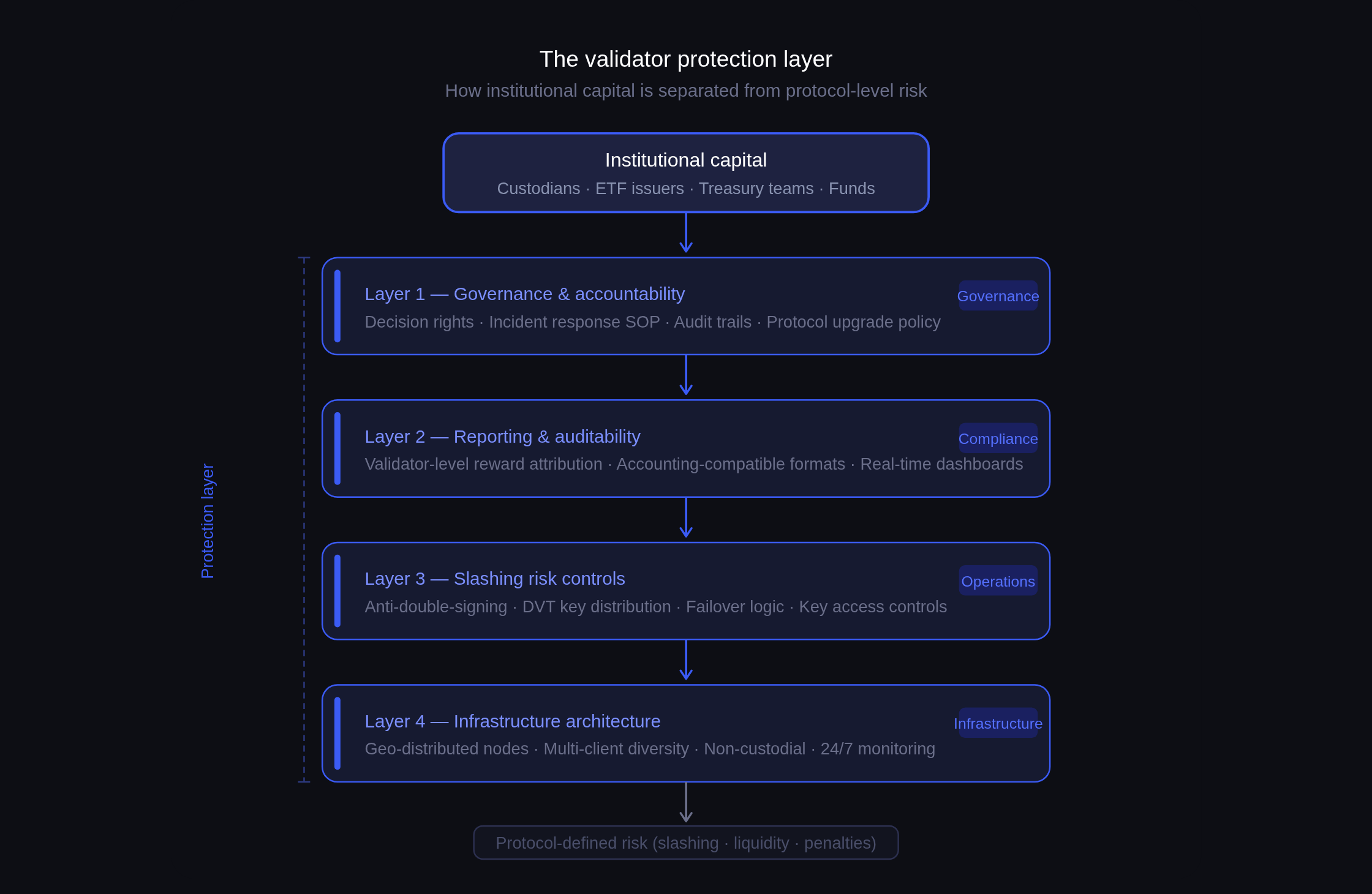
A meaningful protection layer has four components:
1. Infrastructure Architecture
The foundation of any protection layer is how the validator infrastructure is built. Institutions should only partner with providers that maintain validators across multiple regions, operating in independent data centers with geographic diversity, multiple client implementations, and dedicated fallback systems (Aetsoft). Single points of failure at the infrastructure layer are unacceptable at institutional scale.
Distributed validator technology (DVT) is increasingly relevant here. By splitting validator key operations across multiple independent operators, DVT reduces the risk of any single infrastructure failure triggering a slashing event — and reduces key compromise risk structurally, not just procedurally. P2P.org's DVT staking infrastructure is built specifically around this architecture for institutional participants.
2. Slashing Risk Mitigation Protocols
Anti-slashing measures must be built into the validator operation itself, not bolted on afterward. This means enforced key signing controls that prevent double-signing under any operational circumstance, automated failover logic that prioritizes safety over liveness, and real-time monitoring of validator status with immediate alerting.
Providers should offer real-time dashboards, alerting tools, and analytics that track validator performance, slashing events, network participation, and reward flow (Aetsoft). Observability is not optional. It is the operational nervous system of a well-governed staking program.
3. Governance and Accountability Structures
For institutions, governance means documented decision rights, audit trails, and clear accountability for validator operations. Who has the authority to initiate an exit? What is the incident response procedure for a slashing event? How are protocol upgrades evaluated and applied?
As institutional capital flows into proof-of-stake networks, concerns about operational governance highlight the importance of resilient infrastructure, transparent risk controls, and adherence to high compliance standards across staking providers (CoinShares). These are not preferences; they are due diligence requirements that institutional risk committees and investor disclosure obligations demand.
4. Reporting and Auditability
Institutional staking programs require reward attribution at the protocol level, disaggregated by validator and by period, in formats compatible with internal risk systems and external audit requirements. This is not a feature. It is an operational necessity for any entity subject to financial reporting obligations.
P2P.org's Ethereum staking infrastructure is designed with these institutional reporting requirements as a baseline, not an add-on.
The Capital Governance Dimension
Beyond operational risk, there is a deeper question that institutional participants in proof-of-stake networks often underestimate: governance rights.
Staking is not passive. In many proof-of-stake protocols, validators and delegators participate in governance decisions — protocol upgrades, parameter changes, treasury allocations. At the scale of institutional participation now entering these networks, staking infrastructure decisions are governance decisions.
Staking enables institutions to actively participate in the networks they hold, contributing to consensus and security. In many proof-of-stake protocols, stakers gain governance rights, enabling them to vote on protocol upgrades, policy changes, and treasury allocations. This influence can be strategically valuable, allowing institutions to help shape network direction (Coinbase).
For institutional participants with fiduciary obligations like ETF issuers, custodians, fund managers, this creates a new category of governance responsibility. The validator infrastructure partner an institution selects is not just an operational vendor. It is a governance representative.
Validator Partner Evaluation: What Institutions Should Be Asking
Selecting a validator infrastructure partner is a risk management decision. The relevant questions are not primarily commercial. They are operational and architectural.
Key areas of evaluation:
- Infrastructure design: Is the validator infrastructure geographically distributed? Are multiple client implementations supported? What are the failover protocols?
- Slashing risk controls: What technical controls prevent double-signing? How are signing key operations secured and access-controlled?
- Incident history: Has the operator experienced slashing events? What was the root cause, and what architectural changes followed?
- DVT adoption: Does the operator support or plan to support distributed validator technology for key distribution?
- Reporting capabilities: Can the operator provide reward-attribution data at the validator level, in formats compatible with institutional reporting requirements?
- Protocol alignment: How does the operator evaluate and respond to protocol upgrades? Is there a documented governance participation policy?
Due Diligence Checklist
For validator risk committees, compliance teams, and digital asset managers assessing staking infrastructure partners:
- [ ] Validator infrastructure is geographically distributed across independent data centers
- [ ] Multiple consensus client implementations are supported (client diversity)
- [ ] Anti-double-signing controls are enforced at the key management level
- [ ] Automated failover logic prioritizes safety over liveness
- [ ] Real-time monitoring and alerting for validator performance and anomalies
- [ ] Documented incident response procedure for slashing events
- [ ] Audit trail for all validator key operations and access events
- [ ] Reward reporting at validator level, compatible with institutional accounting requirements
- [ ] Documented governance participation policy for protocol upgrades
- [ ] SLA is framed around operational practices, not performance guarantees, so in line with protocol-defined outcomes
- [ ] No custody of client assets (non-custodial architecture confirmed)
FAQ
What is a validator protection layer?
A validator protection layer refers to the combination of infrastructure architecture, operational controls, and governance frameworks that an institution or its validator infrastructure partner deploys to manage the protocol-defined risks of staking participation. It is not a product but a design posture that encompasses distributed infrastructure, anti-slashing controls, key security, incident response protocols, and institutional-grade reporting.
How often does slashing actually occur on Ethereum?
Slashing on Ethereum is rare. Historical data indicates that fewer than 0.03% of all validators have been slashed since the Beacon Chain launched in December 2020. However, correlated slashing events where multiple validators are penalized simultaneously carry amplified penalties due to Ethereum's inactivity leak mechanism. For institutions managing large staked positions, the tail risk of a correlated event is the relevant risk to engineer around, not the average frequency.
Are slashing risks eliminated by using a third-party validator provider?
No. Slashing risks are protocol-defined and client-borne. A validator infrastructure provider can implement robust controls that reduce the likelihood of slashing events through anti-double-signing logic, distributed key management, and high-availability infrastructure, but cannot eliminate protocol-level risk. Institutions should evaluate the quality of a provider's risk controls rather than expecting guarantees.
What is the difference between operational risk and slashing risk in staking?
Slashing is a specific protocol penalty triggered by defined validator misbehaviors, primarily double-signing. Operational risk is broader. It encompasses validator downtime, key management failures, infrastructure outages, and human errors that may result in missed rewards, delayed withdrawals, or, in severe cases, conditions that trigger slashing. A protection layer addresses both categories.
How does validator infrastructure selection affect governance participation?
In many proof-of-stake protocols, validators participate in governance decisions including protocol upgrades and parameter changes. Institutions delegating to a validator provider are, in effect, delegating governance participation. This creates a fiduciary dimension to infrastructure selection that risk committees and compliance teams should account for explicitly.
What should institutions look for in staking reporting capabilities?
Institutional staking programs require reward attribution at the protocol level, disaggregated by validator and period, in formats compatible with internal risk management systems and external audit requirements. Providers should be able to demonstrate reporting capabilities before onboarding, not describe them as a future roadmap item.
Key Takeaway
For digital asset custodians, ETF issuers, treasury teams, and crypto-native funds operating in proof-of-stake networks, the validator infrastructure decision is no longer an operational afterthought. It is a risk management and governance decision with direct capital implications. A protection layer built from distributed infrastructure, enforced anti-slashing controls, non-custodial architecture, and institutional-grade reporting is the baseline expectation for any entity with fiduciary obligations and material staked positions. The question is not whether to implement one. It is whether your current infrastructure partner is actually providing one.
Protocol-generated rewards are determined by network conditions and are variable. P2P does not control or set reward rates. Slashing risks are protocol-defined and client-borne.
Disclaimer
This article is provided for informational purposes only and does not constitute legal, regulatory, compliance, or investment advice. Regulatory obligations may vary depending on jurisdiction and specific business activities. Readers should consult their own legal and compliance advisors regarding applicable requirements.
Fito Benitez